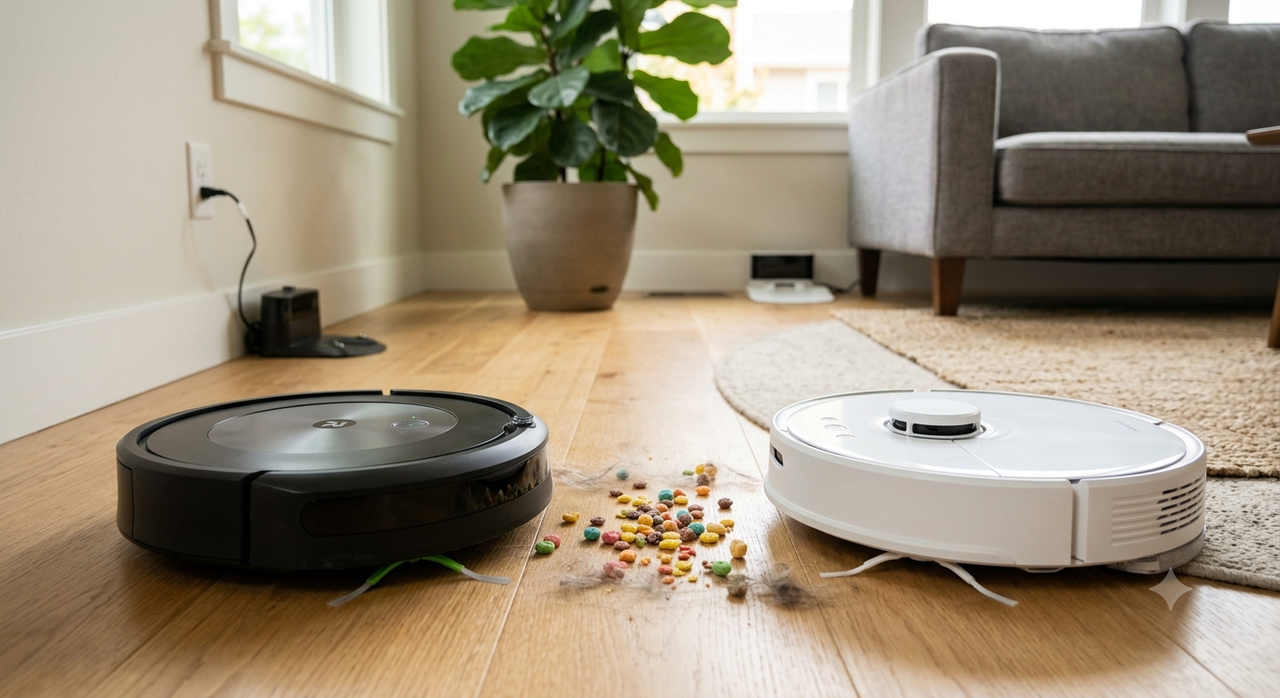
Introduction
Choosing a robot vacuum used to be simple when "Roomba" was practically synonymous with the entire category. Today, two names dominate the market with genuinely different philosophies: Roomba, the veteran American brand that invented the category, and Roborock, the Chinese brand that overtook it in navigation precision and price-to-performance ratio in recent years.
The problem is that both companies launched large, confusingly similar 2026 lineups (Plus and Max on one side, Qrevo and Saros on the other), which makes a direct comparison genuinely hard for an ordinary shopper scrolling through near-identical product pages on Amazon.
The most common mistake buyers make is judging a robot purely by its suction number in Pascals. A headline figure like 22,000Pa doesn't automatically mean better cleaning if the navigation algorithm is weak or the brush tangles with pet hair every day. Another frequent mistake is buying a model with a massive "does-everything" dock (auto-empty, mop washing, hot-air drying) for a small apartment that doesn't need that level of automation, when a simpler dock would have saved hundreds of dollars.
This YallaBuy guide breaks the two philosophies down step by step — navigation, suction, mopping, maintenance, app experience, and price — then reviews the standout 2026 models from each brand, so you can choose based on your actual home and budget rather than brand loyalty alone.
At-a-Glance Comparison Table
| Product | Standout Feature | Target User | Price Tier |
|---|---|---|---|
|
Roborock Saros 10R Roborock |
Retractable LiDAR tower + 22,000Pa suction | Buyers who want top-tier performance without a mechanical arm | Premium |
|
Roborock Qrevo Curv 2 Flow Roborock |
Full wash-and-dry dock at a mid-range price | Families who want luxury features without flagship pricing | Mid-to-high |
|
Roborock Q10 S5 / Q8 Max Roborock |
Best value inside the Roborock lineup | Budget-conscious buyers who still want real LiDAR navigation | Mid-range |
|
iRobot Roomba Max 775 Combo iRobot |
30,000Pa suction with hot-water mopping and pre-spray | Large homes and pet households | Premium |
|
iRobot Roomba Plus 675 Combo iRobot |
Heated roller mopping with an AutoWash dock | Mid-size families wanting all-around cleaning | Mid-to-high |
|
iRobot Roomba 115 iRobot |
Ultra-compact, low-profile design | Small apartments and low furniture clearance | Budget |
01. Roborock Saros 10R — The Performance Flagship
Key Specifications
- Suction up to 22,000Pa
- Retractable LiDAR tower that lowers the robot's body to slide under low furniture
- FlexiArm side brush that extends into tight corners
- Hot-water dock that washes and dries the mop pads
Real-World Performance
The standout feature of the Saros 10R isn't the suction number, it's the robot's ability to physically lower itself by retracting the LiDAR tower when approaching low furniture, something fixed-tower competitors simply can't do. The extending side arm actively pushes debris out of sharp corners instead of leaving it behind the way a standard side brush does. In daily use, this translates into corner and under-couch coverage that's genuinely hard for same-price competitors to match.
● Pros
- Top-tier navigation — Spinning LiDAR paired with the StarSight algorithm is among the most precise on the market.
- Feature-rich app — Room-specific cleaning, no-go zones, and granular per-room scheduling.
- Near-hands-off dock — Reduces manual intervention to roughly once a month.
● Cons
- Flagship price — Not every home needs every feature it offers.
- Large dock — Needs dedicated floor space.
- Early firmware updates — Some early buyers reported needing frequent updates right after launch.
Who Should Buy This
Owners of large, multi-floor homes with pets and low furniture who want minimal hands-on maintenance and aren't constrained by budget.
check price on amazon
02. Roborock Qrevo Curv 2 Flow — The Value-to-Luxury Balance
Key Specifications
- Curved dock design (Curv) that takes up less floor space than traditional docks
- Automatic bin emptying plus mop washing and hot-air drying
- Strong suction within the upper-mid tier (below Saros-level output)
Real-World Performance
This model specifically targets buyers who wanted the Saros experience but balked at the price. They get most of the automation convenience — emptying, washing, drying — without the retractable tower or the side arm. The biggest gap shows up under low furniture, where this model's fixed height can't compete with the Saros.
● Pros
- Smaller dock footprint — Takes less floor space than competitors offering the same functions.
- Excellent price-to-performance — Strong value inside Roborock's own lineup.
- Unified Roborock app — No relearning for existing Roborock owners.
● Cons
- No under-furniture retraction — Doesn't fit under very low furniture the way the Saros does.
- No corner arm — Some sharp corners are left less than fully clean.
- Early-batch water-sensor glitches — Some first-batch units reported minor water-level sensing issues in the dock.
Who Should Buy This
Mid-size families who want near-zero-maintenance convenience without paying full flagship price.
check price on amazon
03. Roborock Q-Series (Q8 Max, Q10 S5) — Best Value in the Brand
Key Specifications
- Real LiDAR navigation (not a camera-only or random-bounce system)
- Simpler docks: most models offer auto-emptying only, without advanced mop washing
- Solid suction for the budget-to-mid tier
Real-World Performance
The important thing here is that Roborock didn't cut corners on navigation in its budget tier the way some rivals do. The Q-series uses nearly the same LiDAR found in higher tiers, just without the dock luxuries. The result is accurate home mapping and logical cleaning paths even in the more affordable models.
● Pros
- Reliable navigation at a low price — Significantly cheaper than the Saros or Qrevo while still mapping properly.
- Full-featured app — Despite the lower price, you get the same Roborock app experience.
- Strong first-robot choice — A great entry point for a household new to the category.
● Cons
- Simpler dock — More manual intervention (emptying and hand-washing the mop).
- Lower suction — May not be enough for very thick carpet.
- Some models lack visual object recognition — Cords and clothing can be a problem on certain Q variants.
Who Should Buy This
Budget-conscious buyers with hard floors or thin carpet who don't mind hand-washing the mop pad every few days.
check price on amazon
04. iRobot Roomba Max 775 Combo — The Most Powerful Model in the New 2026 Lineup
Key Specifications
- Suction up to 30,000Pa — a record figure for the new Roomba lineup
- ClearView Pro LiDAR navigation with PrecisionVision AI obstacle recognition
- Self-cleaning PowerSpin mop with water heated to roughly 167°F (75°C)
- Dual anti-tangle brushes to reduce pet-hair wraparound
- AutoWash dock that empties the bin and washes and dries the mop
Real-World Performance
After years of relying on older navigation systems, this generation finally adopts standard LiDAR instead of camera-only navigation — a fundamental shift that noticeably improved mapping accuracy. The high suction figure translates into genuinely strong pet-hair pickup from thick carpet, and the pre-treatment hot spray actually helps break down dried-on stains before the mop passes over them instead of just smearing them.
● Pros
- First Roomba generation with LiDAR as standard — A major upgrade over older camera-only models.
- Real hot-water mopping — Not just a cold spray like previous generations.
- Low-maintenance dock — iRobot claims it can cut manual intervention to roughly once every three months.
● Cons
- Premium-tier price — Cheaper than last generation's flagship, still not cheap.
- Bulker than the Saros 10R — May not fit under very low furniture.
- App is less detailed than Roborock's — Fine-grained per-room settings are still more limited.
Who Should Buy This
Large households with pets and thick carpet, or buyers who trust iRobot's long track record of reliability over a newer entrant's app polish.
05. iRobot Roomba Plus 675 Combo — The Family Balance
Key Specifications
- Heated roller mopping at up to roughly 140°F (60°C)
- Thermal pre-spray to loosen dried-on stains before cleaning
- ClearView Pro LiDAR with visual obstacle recognition
- Full AutoWash dock (emptying, washing, and drying)
Real-World Performance
This is the direct competitor to Roborock's Qrevo Curv 2 in philosophy: most of the flagship-tier convenience at a lower price. The heated roller handles everyday stains effectively (spilled coffee, footprints), but it doesn't match the raw suction power of the higher Max tier.
● Pros
- Mid-range price for a near-flagship dock — Closer to mid-range than the Max 775.
- Near-complete maintenance dock — Empties, washes, and dries despite the lower price.
- Good visual recognition — Identifies common obstacles like cords and shoes.
● Cons
- Lower suction than the Max 775 — Less impressive on thick carpet.
- No dedicated corner solution — Some sharp corners will be left less than perfectly clean.
- Bulky dock — Bulkier than Roborock's curved Qrevo dock.
Who Should Buy This
Mid-size families with mixed flooring (tile plus thin carpet) who want thorough care without paying flagship-tier prices.
check price on amazon
06. iRobot Roomba 115 — The Budget Entry Point
Key Specifications
- Suction up to 15,000Pa
- A compact, low-profile design that fits under moderately low furniture
- Vacuum-only, no mopping
- No auto-empty dock in the base version
Real-World Performance
This is the entry point into the Roomba ecosystem, purpose-built for small apartments where a bulky dock isn't practical. Suction is sufficient for daily use (dust, crumbs, human hair) but it's not the right pick for households with heavy-shedding cats or dogs.
● Pros
- One of the most affordable Roombas with modern navigation — A real upgrade at the low end.
- Compact size — Well-suited to apartments and limited storage space.
- Solid first robot vacuum — A good start for a household new to the category.
● Cons
- No mopping — Anyone needing wet cleaning of hard floors needs a separate device.
- No auto-emptying — Bin needs manual emptying after nearly every run.
- Significantly weaker suction — Noticeably behind the Plus and Max tiers.
Who Should Buy This
A small apartment or single bedroom with simple flooring and a limited budget, where mopping and full automation aren't required.
07. The Ultimate Buying Guide: How to Choose Between Roomba and Roborock
1. Navigation: The Most Important Technical Factor
Both brands now use LiDAR in most of their 2026 flagship and mid-range models, a significant shift given that iRobot relied on camera-only systems for years. The practical difference today is more subtle: Roborock's algorithms (especially StarSight) tend to produce more accurate maps for multi-floor homes and faster identification of no-go zones. iRobot, meanwhile, added PrecisionVision — a visual recognition layer on top of LiDAR that identifies obstacle types (a shoe, a cord, pet waste) with higher accuracy than simply avoiding them. In simple terms: if mapping accuracy in a complex home is your priority, Roborock tends to have the edge; if avoiding small daily obstacles matters most, especially with pets, iRobot's visual system makes a real difference.
2. Suction: The Number Isn't the Whole Story
Pascal (Pa) figures alone don't tell the full story. A rating of 30,000Pa on the Roomba Max 775 looks higher than the Saros 10R's 22,000Pa, but the real-world gap on standard carpet or hard floors is often less noticeable than the numbers suggest. The real difference shows up on very thick carpet or deeply embedded pet hair. Bottom line: don't buy on the highest number alone — ask what your actual flooring looks like first.
3. Mopping: Two Different Philosophies
Roborock generally relies on dual rotating mop pads that automatically lift when they detect carpet, while the latest Roomba generation uses a single heated roller with hot water and a pre-treatment spray. Roborock's dual rotating pads tend to clean hard floors more thoroughly, while Roomba's thermal pre-spray system is especially effective on old, dried-on stains specifically.
4. Maintenance and the Dock
Both brands now offer "AutoWash"-style docks in their higher tiers: bin emptying, mop washing, and hot-air drying. The real difference lies in dock footprint and placement; Roborock's Curv-series docks are engineered to occupy less floor space, while Roomba's higher-end docks are bulkier but reportedly quieter during overnight cycles according to user reports.
5. App and User Experience
Roborock's app has traditionally been the most detailed on the market: precise per-room suction control, complex-shaped no-go zones, and multi-tier scheduling. iRobot's app improved significantly in 2026 but remains comparatively simpler, a plus for anyone who wants quick setup without digging through sub-menus.
Common Buying Mistakes on Amazon
- Judging a unit by its Pascal rating alone without checking your home's actual flooring type.
- Buying a model with a massive dock for a small apartment that has no real storage space for it, when a simpler dock would have been cheaper and sufficient.
- Skipping long-term maintenance reviews, since some very new models don't yet have a full year of reliability data available.
- Assuming every "smart" model avoids cords and pet waste automatically — that's exclusive to models with genuine visual recognition (PrecisionVision or its equivalent), not a standard feature across every budget tier.
- Overlooking smart-home compatibility (Alexa, Google Home, etc.) when it matters to your daily routine, then discovering the gap only after purchase.
Frequently Asked Questions
Quick answers to the most common questions about the Roomba vs Roborock decision in 2026, based on the official spec sheets, independent testing, and how each robot performs in real homes.
Is Roborock generally better than Roomba?
There's no single answer that fits everyone. Roborock typically leads in navigation precision, granular app control, and price-to-performance in the mid-range. The latest Roomba generation, however, leads in raw suction power and fine-grained visual obstacle detection. The right choice depends on your actual priorities.
Is it worth paying flagship prices (Saros or Roomba Max) instead of a mid-range model?
Only if your home is genuinely large, multi-floor, or if you have pets that create daily messes requiring frequent deep cleaning. For an apartment or mid-size home with simple flooring, the mid-range tier (Qrevo or Roomba Plus) offers much better value.
Do you actually need a full auto-empty-and-wash dock?
If you have time to empty the bin and wash the mop manually on a regular basis, you can save a meaningful amount of money by buying a model without a full-service dock. Complete docks specifically target buyers who want minimal hands-on involvement, not an absolute necessity for every household.
Do the new Roomba models genuinely compete on navigation now that they use LiDAR?
Yes. Standardizing LiDAR across the 2026 lineup closed much of the gap with Roborock. The remaining difference is mostly in software details and map-refresh speed rather than core sensor quality.
What's the practical difference between 15,000Pa and 30,000Pa of suction?
On hard floors and thin carpet, the difference may barely be noticeable in daily use. The real difference shows up with thick carpet and pet hair deeply embedded in fibers, where higher suction genuinely becomes necessary rather than just a nice-to-have.
Are the budget models from the Q-series or entry-level Roomba worth buying?
Yes, for buyers with clear priorities: relatively simple flooring, no heavy-shedding pets, and a limited budget. These tiers deliver genuine LiDAR navigation at a reasonable price, but they require more manual maintenance.
Do these robots work well in multi-floor homes?
Both brands support saving multiple floor maps in their mid-range and premium tiers, but the unit itself needs to be manually carried between floors (or you need an additional dock) since the robots don't climb stairs on their own in consumer-grade models.
Is dock noise disruptive at night?
Noise levels vary by model, but most hot-air drying docks produce noticeable sound for several minutes after each cleaning cycle. Anyone planning to run the robot overnight should check the specific noise rating for each model before buying.
Is it worth buying a model with a mechanical arm, like the Saros Z70?
This is a highly specialized feature that most users don't actually need. It mainly targets households with young children or recurring floor clutter (toys, socks) who want a fully automated solution. For most homes, this feature adds significant cost for limited practical benefit.
Final Verdict
There's no absolute winner between Roomba and Roborock in 2026, and the truth is each brand closed the gap that separated it from the other just a few years ago: Roomba finally adopted LiDAR, and Roborock kept pushing suction power and smart maintenance further. The real decision comes down to three questions you should ask before opening the checkout page: how big is your home and what's your flooring like? Do you have pets that shed heavily? And how much manual maintenance time are you realistically willing to put in each week?
If you want the sharpest navigation precision and the most granular app control, Roborock is your pick, especially in the mid-range where its price-to-value ratio is at its strongest. If you want the highest raw suction power and reliable visual recognition of everyday obstacles, particularly in large homes with pets, the new Roomba generation is a genuinely competitive option for the first time in years. Either way, start from your actual budget and home's needs, not brand loyalty alone.
References & Further Reading
- Official Roborock product pages for the Saros 10R, Qrevo Curv 2 Flow, and Q-series (Q8 Max / Q10 S5) — 2026 model year.
- iRobot official product pages and spec sheets for the Roomba Max 775 Combo, Roomba Plus 675 Combo, and Roomba 115.
- Independent robot-vacuum testing references covering debris pickup, carpet deep cleaning, obstacle avoidance, and hair tangling for both brands.
- Amazon marketplace rating snapshots and verified buyer reviews for Roomba and Roborock 2026 lineups (Q1–Q3 2026).
- YallaBuy hands-on testing notes and editorial buying-guidance framework.