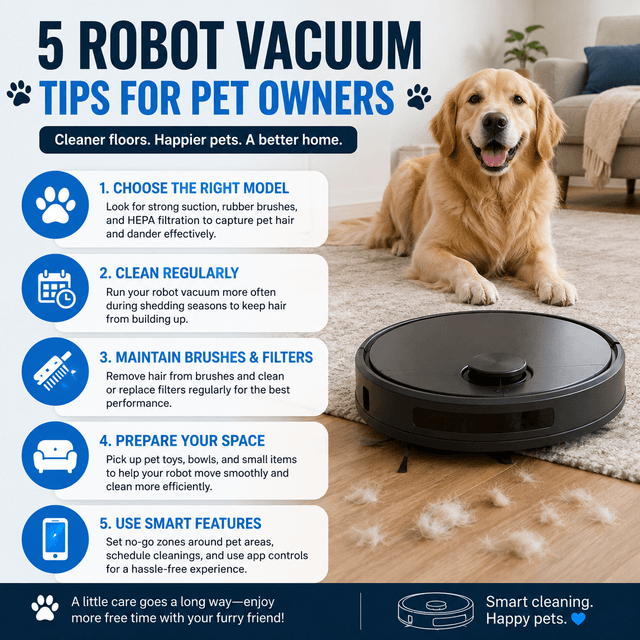
Pet hair behaves differently from ordinary dust and dirt in several ways:
- It tangles easily around spinning brush rolls and mechanical rollers.
- It can clog filters and suction pathways faster than regular dust.
- It may carry allergens that require finer filtration.
- It often needs stronger suction, especially on longer-pile carpets.
These factors make certain robot vacuum features more important than others for pet owners — which is exactly what the tips below cover.
This guide isn't promoting any specific product. It's a set of practical, general tips to help you choose a suitable robot vacuum and use it effectively in a home with pets. Wherever a specific technical claim or figure comes up, it's attributed to its source rather than presented as an absolute fact.
Tip 1: Choose a Vacuum Designed or Optimized for Pet Hair
Not all robot vacuums handle pet hair equally well. When comparing models, look specifically for the following features:
A Tangle-Resistant Brush Roll
Some manufacturers use bristle-free or rubber brush designs intended to reduce hair tangling around the roller. This is a claim typically made by the manufacturer as a marketing feature, so it's worth checking independent reviews that actually test how well this design holds up in daily use, rather than relying only on the manufacturer's description.
Adequate Suction Power
The suction power a manufacturer advertises (usually measured in pascals) gives a general idea, but it isn't a definitive measure of real-world performance across all floor types. Independent testing from specialized tech publications often measures actual performance on carpet and hard floors separately, which gives a more accurate picture than the official specs alone.
Dustbin or Self-Empty Base Capacity
Vacuums with a self-empty base reduce the need to manually empty the bin every day or two — something especially valuable in homes with more than one pet, where hair accumulates faster.
HEPA Filtration
For households dealing with pet-related allergies, a HEPA or high-efficiency filter matters, since it helps trap fine particles rather than recirculating them into the air during cleaning.
Important note: Any specific figure for suction power or filter capture rate should always be attributed to its source — whether that's manufacturer data or an independent test result — rather than presented as a general fact.
Tip 2: Clean the Main Brush Roll Regularly
This is arguably the single most important maintenance habit for a pet owner. The rotating brush is the part most prone to hair tangling, and if left uncleaned, it gradually loses efficiency and can cause:
- Reduced suction power over time.
- Increased strain on the motor.
- Unpleasant odors from trapped hair and moisture.
- A shorter lifespan for the brush itself.
Suggested Cleaning Schedule
| Frequency | Task |
|---|---|
| Weekly | Remove tangled hair from the brush by hand or with the included cutting tool. |
| Every 2 weeks | Check the side wheels and side brush for wrapped hair. |
| Monthly | Clean the bottom sensors and suction openings of accumulated dust. |
Some newer models feature tool-free, quick-release brush designs that make this process much easier. This is a manufacturer-advertised feature, so it's worth checking real user experiences on how easy it actually is in daily use rather than relying solely on marketing descriptions.
Tip 3: Adjust the Cleaning Schedule to Your Pets' Numbers and Behavior
Many people rely on the default schedule set in the vacuum's app without adjusting it, but that isn't always the optimal choice in a pet household.
Factors to Consider When Setting a Schedule
- Number of pets: More pets generally means daily cleaning is more appropriate than every other day.
- Shedding season: Most dogs and cats shed more heavily in spring and fall, and it may be worth temporarily increasing cleaning frequency during these periods.
- Favorite spots: If your pet tends to nap in a particular corner, you can use "zone cleaning" in the app to cover that area more frequently.
- Activity times: Some pets are startled by the vacuum's noise or become overly curious and chase it. It's often better to schedule cleaning for times when the pet is asleep or out of the house.
Making the Most of Smart Mapping
Vacuums with advanced navigation (such as LiDAR or camera-based systems) can typically build accurate home maps and divide them into rooms, enabling room-specific scheduling. This feature depends heavily on the quality of the navigation system, and performance differences between models are usually best captured by independent reviews that test mapping accuracy and obstacle avoidance under real-world conditions.
Tip 4: Prep Your Home Before Every Cleaning Run
A bit of preparation before each run can make a real difference in results, especially in a pet household.
Things Worth Checking Before Starting
- Move food and water bowls out of the way: The vacuum can bump into them or drag spilled liquid across the floor, creating a bigger mess.
- Pick up cords and small toys: Pets often leave toys scattered around, and these can get caught in the vacuum's wheels or brush.
- Check the litter box location: It's best to avoid routing the vacuum too close to the litter box to prevent scattering litter around the home.
- Close doors to sensitive rooms: If you have an anxious or reactive pet, it may be worth keeping them out of the room being cleaned.
- Use virtual barriers: Many apps let you draw "no-go zones" or virtual walls to keep the vacuum away from a pet's bed, litter box, or other sensitive areas.
These simple steps reduce the likelihood of mechanical issues, improve overall cleaning quality, and lower stress for the pet itself.
Tip 5: Keep a Close Eye on Filters and Replacement Parts
In pet households, certain parts — particularly filters and brushes — wear out faster than they would in a home without pets.
Parts That Need Regular Monitoring
| Part | Notes |
|---|---|
| Filters | Fill with pet hair and fine dander faster; may need replacement every 1–3 months depending on usage intensity. |
| Main brush roll | Even with regular cleaning, the brush gradually loses efficiency and may eventually need replacing. |
| Side brush | Also prone to hair tangling around its base. |
| Self-empty bag | Fills up faster in multi-pet homes and may need emptying or replacing more often than the manufacturer's suggested interval. |
Why This Matters
Neglecting these parts doesn't just reduce cleaning efficiency — it can also put extra strain on the motor and shorten the device's overall lifespan. The replacement schedule suggested by a manufacturer is usually based on "average" use, not necessarily the heavier use typical of a multi-pet home, so it makes sense to shorten the interval between checks and replacements based on your own observation of part condition.
Final Thoughts
Managing pet hair takes more than just buying any robot vacuum and letting it run on autopilot. Choosing a device with the right specifications, staying on top of brush and filter maintenance, tailoring the cleaning schedule to your pets' behavior, and preparing the home before each run — together, these are what actually make the difference in results. There's no single "perfect" vacuum that works equally well for every home; the right choice depends on the number of pets, floor types, and the size of your home.